Instructions
- Prepare Your Workspace and Pan: Preheat your oven to 350°F (175°C). Line a 10×15-inch (25×38 cm) jelly roll pan with parchment paper, leaving an overhang on the short sides to help with lifting. Lightly grease the parchment paper.
- Sift Dry Ingredients: In a medium bowl, whisk together the sifted cake flour, baking powder (if using), and salt. Set aside.
- Whip Egg Yolks: In a large bowl, whisk together the egg yolks and 1/4 cup (50g) of the granulated sugar until pale yellow and slightly thickened (this can take 2-3 minutes with a hand mixer). Stir in the vanilla extract, milk, and oil/melted butter until well combined.
- Combine Wet and Dry: Gradually add the dry ingredients to the egg yolk mixture, mixing gently until just combined and no streaks of flour remain. Be careful not to overmix.
- Whip Egg Whites: In a separate, very clean bowl (preferably a stand mixer bowl with a whisk attachment), beat the egg whites on medium speed until soft peaks form. Gradually add the remaining 1/4 cup (50g) of granulated sugar, increasing the speed to high, and continue to beat until stiff, glossy peaks form. The meringue should be firm and hold its shape.
- Fold Meringue into Batter: Gently fold one-third of the whipped egg whites into the egg yolk batter to lighten it. Then, carefully fold in the remaining egg whites in two additions, using a spatula to gently cut through the mixture and fold it over itself. Work quickly and gently to maintain as much air as possible, ensuring no large streaks of egg white remain.
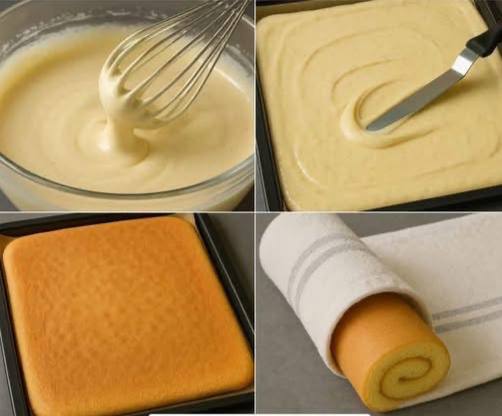
- Spread and Bake: Pour the batter onto the prepared jelly roll pan. Use an offset spatula to gently and evenly spread the batter to the edges of the pan, ensuring a consistent thickness (refer to Image 2). Bake for 10-12 minutes, or until the cake is golden brown, springs back when lightly touched, and a toothpick inserted into the center comes out clean (refer to Image 3).
- Prepare for Rolling: While the cake is baking, lay out a clean, lint-free kitchen towel on your counter. Lightly dust the towel with powdered sugar. This prevents sticking and adds a bit of sweetness to the exterior of the cake.
- The Crucial First Roll (Hot Roll): Immediately upon removing the cake from the oven, invert the hot cake onto the prepared sugared towel. Carefully peel off the parchment paper. Starting from one of the short ends, gently but firmly roll the cake and the towel together into a tight log (refer to Image 4). Place the rolled cake, seam-side down, on a wire rack and allow it to cool completely in its rolled shape, for at least 1-2 hours. This step is vital for the cake to “memorize” its rolled form and prevent cracking later.
- Prepare the Filling: Once the cake is completely cool, prepare your filling. In a large, chilled bowl, combine the very cold heavy cream, powdered sugar, and vanilla extract. Beat on medium-high speed until firm peaks form. Be careful not to overbeat, or it will become grainy.
- Unroll and Fill: Gently unroll the cooled cake. It should retain its rolled shape. Evenly spread the berry jam over the entire surface of the cake, leaving a small border (about 1/2 inch) around the edges. Then, spread the whipped cream evenly over the jam layer, again leaving a small border.
- Re-Roll and Chill: Starting from the short end where you began the initial roll, carefully re-roll the cake tightly, without the towel this time. Once rolled, wrap the Swiss Roll snugly in plastic wrap. Refrigerate for at least 1 hour (or up to 4 hours) to allow the filling to set and the cake to firm up, which makes slicing much easier.
- Garnish and Serve: Before serving, carefully unwrap the chilled Swiss Roll. Trim about 1/2 inch off each end using a sharp, serrated knife to create neat, clean edges. Dust generously with powdered sugar, and if desired, garnish with fresh berries. Slice into 1-inch thick rounds and serve immediately.
Cooking Tips and Variations
Precision with Ingredients: For the best results, use a kitchen scale to measure your flour for accuracy. Sifting the cake flour is also crucial for a light, airy sponge. Ensure your eggs are at room temperature as they whip up with more volume.
Don’t Overbake: Overbaking is the number one enemy of a flexible sponge cake. Keep a close eye on it; it should be lightly golden and spring back when gently touched. An overbaked cake will dry out and crack when rolled.
The Hot Roll is Key: Rolling the cake while it’s still warm and immediately after baking is non-negotiable. The heat helps the cake retain its flexibility. The towel absorbs moisture and helps the cake “set” in its rolled shape as it cools. Don’t skip the powdered sugar on the towel – it prevents sticking and can add a subtle sweetness to the exterior.
Gentle Folding: When incorporating the whipped egg whites into the batter, use a light hand and a folding motion. This preserves the air you’ve worked hard to incorporate, which is essential for a tender, aerated sponge. Overmixing will deflate the batter, resulting in a dense cake.
Even Spreading: Take your time to spread the batter evenly in the pan. A consistent thickness ensures uniform baking and a beautifully even spiral in the finished roll.
Flavor Variations:
- Chocolate Swiss Roll: Substitute 2 tablespoons of the cake flour with 2 tablespoons of unsweetened cocoa powder. For the filling, use chocolate ganache (1 cup heavy cream, 8 oz chopped dark chocolate) or chocolate whipped cream.
- Lemon Swiss Roll: Add 1-2 teaspoons of lemon zest to the sponge batter. For the filling, use lemon curd combined with whipped cream, or a lemon cream cheese frosting.
- Coffee Swiss Roll: Add 1-2 teaspoons of instant espresso powder dissolved in the milk for the sponge. Fill with coffee-flavored whipped cream or a mocha buttercream.
- Tropical Swiss Roll: Fill with passion fruit curd, mango puree, or coconut whipped cream. A sprinkle of toasted coconut flakes on top would be delicious.
- Cream Cheese Filling: Beat 8 oz cream cheese (softened) with 1/2 cup powdered sugar, 1/4 cup softened butter, and 1 teaspoon vanilla extract until smooth. This makes a richer filling.
Storage and Reheating
Storage: A finished Swiss Roll, especially with a whipped cream or cream cheese filling, should be stored in an airtight container in the refrigerator. It will stay fresh and delicious for 2-3 days. If your filling is jam-only, it might last a little longer, but refrigeration is still recommended for optimal freshness and food safety.
Freezing: You can freeze an unfilled, rolled sponge cake (without the towel) by wrapping it tightly in plastic wrap, then aluminum foil. It will keep for up to 1 month. Thaw in the refrigerator overnight before unrolling and filling. A fully assembled Swiss Roll with a cream-based filling generally doesn’t freeze well as the cream can separate upon thawing, affecting the texture. However, a Swiss Roll with a buttercream or ganache filling can be frozen, wrapped well, for up to 2-3 weeks. Thaw in the refrigerator.
Reheating: A Swiss Roll is best served chilled or at cool room temperature. It is not typically reheated. Reheating would melt the filling and alter the delicate texture of the sponge cake. Simply remove it from the refrigerator about 15-20 minutes before serving to allow it to slightly soften, enhancing its flavors and textures.
Frequently Asked Questions
Why did my Swiss Roll crack when I unrolled it?
Cracking is the most common issue when making a Swiss Roll, and it’s usually due to one of three reasons: the cake was overbaked, making it dry and brittle; it wasn’t rolled immediately while still warm, losing its flexibility; or it wasn’t rolled tightly enough in the towel, preventing it from setting its shape properly. Ensure you bake just until done, roll it hot, and roll it firmly with the towel.
Can I use all-purpose flour instead of cake flour?
While you can, it’s not ideal. Cake flour has a lower protein content, which results in a much finer, softer, and more tender crumb that is less prone to cracking. If you must use all-purpose flour, you can try to replicate cake flour by removing 2 tablespoons of all-purpose flour from each cup and replacing it with 2 tablespoons of cornstarch, then sifting well. This will help achieve a more delicate texture.
How can I prevent my Swiss Roll from sticking to the parchment paper or towel?
For the parchment paper in the pan, make sure it’s lightly greased after lining. For the towel, dusting it generously with powdered sugar is crucial. The sugar creates a non-stick barrier and also adds a nice, subtle sweetness to the exterior of the cake. Make sure your towel is clean and lint-free.
What if my whipped cream filling isn’t firm enough?
Ensure your heavy cream is very cold, preferably chilled in the refrigerator for several hours or even briefly in the freezer (5-10 minutes) before whipping. Also, make sure your mixing bowl and whisk are chilled. Overbeating can also cause whipped cream to become grainy or separate, so stop as soon as firm peaks form. If it’s still too loose, you might try adding a small amount of cream cheese (softened) or a stabilizer like a tiny pinch of cornstarch or gelatin (dissolved properly) to your cream before whipping, but generally, cold cream and appropriate whipping technique suffice.
Conclusion
And there you have it – the delightful journey from simple ingredients to a show-stopping Swiss Roll. There’s an undeniable joy that comes from presenting a dessert you’ve crafted with your own hands, especially one as elegant and inviting as this. The delicate sponge, the luscious filling, the satisfying spiral – each element contributes to a homemade confection that far surpasses anything you’d find in a store.
Baking a Swiss Roll is more than just following a recipe; it’s an act of culinary creativity and a testament to the rewards of patience and precision. While the rolling step might seem daunting at first, with a little practice and confidence, you’ll master the technique and find immense satisfaction in creating such a beautiful treat. The aroma filling your kitchen, the golden-brown perfection emerging from the oven, and the delighted smiles of those who taste it – these are the moments that make baking truly special.
So, don’t hesitate! Gather your ingredients, prepare your pan, and dive into the wonderful world of Swiss Roll baking. Whether it’s for a special occasion or simply a sweet indulgence for yourself and your loved ones, this recipe promises a dessert that’s not only delicious but also a true celebration of homemade goodness. Happy baking, and enjoy every delightful slice!